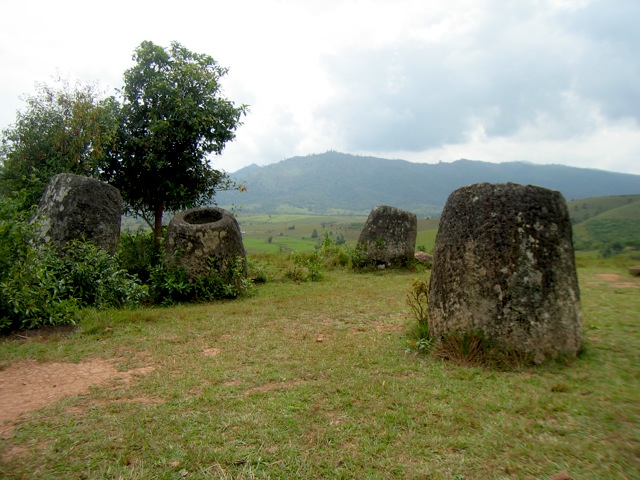
 The Plain of Jars is one of northern Laos' biggest tourist attractions. There are three main sites where the mysterious hand-carved rock jars can be found. I like to say it is Laos' version of Stonehenge: no one knows who made the jars, or what they were made for.
I wasn't planning on coming to see the jars, but after struggling to find a decent travel itinerary with my travel agent (I'll spare you the details), they were put back on the list. So after flying into Xieng Kuang Province, and spending the night in the town of Phonsavan, I got up early this morning, rented a motorbike, and headed out into the countryside.
After getting a little lost, and a short rain shower, I finally found the Plain of Jars Site #2. Sure enough, the jars were a bit underwhelming. There were several here scattered around the top of a few hilltops. I must have been the first one to the site that day, for as I approached the jars, a herd of cattle guarding the jars decided that they would wake up and amble off, shooting me dirty looks for interrupting their naps.
But the surrounding countryside was quite amazing. And again, I felt a million miles from the noise of Bangkok. Instead of motorcycles and tuk-tuks and blaring loud speakers and security guard whistles, I heard the wind blowing through the trees, the crickets in the grass, the tinkling of cow bells off in the distance. I stood there on the top of the mountain with my eyes closed, catching the sounds of the valley as they floated past me on the breeze.
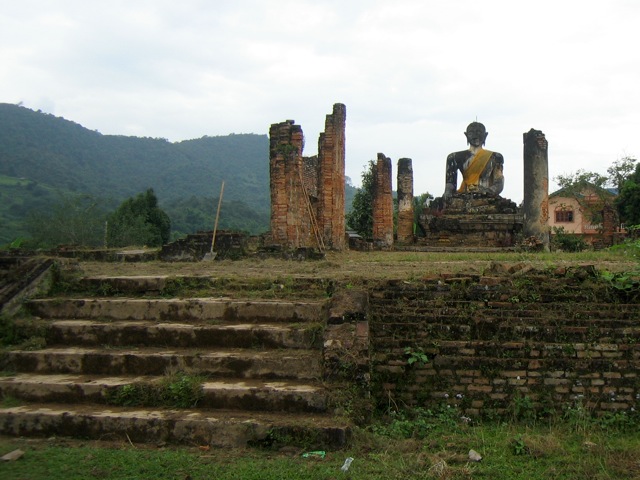 Eventually I left the jars on my motorbike and headed down the road a little farther, to the small town of Muang Khun. There, I visited a couple of temples that were destroyed by the US during the Vietnam War. Seeing something like this always makes me a little sad. Whether or not we should have been bombing Laos at the time is debatable, but to see an old Buddhist temple destroyed in the middle of a village shows that there was probably a lot of innocent lives lost.
But that is old history now, and the people of Muang Khun (and the rest of Laos) seem to be looking forward. As I slowly puttered through the town, people smiled and waved at me. And on one dirt road in particular, this one high-school aged boy waved and said hi, and then chased me down on his bicycle.
"Hi, my name is Touher. Can I talk to you?"
 Sure, why not? I was trying to find the way up to an old overgrown stupa at the top of the hill, but couldn't figure out how to get there. So I asked Touher to show me.
We were soon joined by several other boys, and an impromptu English class started. I learned that they were not Lao, but members of the Hmong hilltribe. Not only were they learning English language in school, but were also studying Lao as a foreign language. They were very excited to see an English-speaking foreigner to practice their language skills with.
Eventually I had to say goodbye to Touher and his friends, and the town of Muang Khun and head back to my hotel. I returned the bike, had another great Lao dinner (with more Beer Lao, of course), and went to bed early, along with the rest of the citizens of quiet Phonsavan. I drifted off to sleep wondering what it is like to have to learn two foreign languages at once: Lao for surviving day-to-day life, and English for a hopeful future.
(This entry describes my experiences on October 9, 2008.)

